 Rick Wright
Online Trading Academy
Hello traders! This week’s newsletter comes to you from snowy and sunny Colorado, where I have officially semi-retired. What does semi-retirement really mean? Well, I still get to write these newsletters every few weeks, and Online Trading Academy is still kind enough to get me around the country to cool towns to spread the gospel according to St. Market. If all I did was stay at home and trade in this snowy tundra, I would go stir crazy!
The reason I bring this up is that a couple of weeks ago I was in Boston, Massachusetts teaching one of our three-day Market Timing Orientation classes, and a student had an interesting question about conventional technical analysis.
His question was a common one: “What do you think about moving averages?” My answer was the same as it always is when someone asks about conventional technical analysis. “It depends. Does it help you or hurt you making money in the markets? Every ‘technique’ has its time and place, but most people don’t know how to use these tools properly.”
As we have discussed in previous newsletters, most of these indicators lag the market, which basically means they are late to the party. A couple of extremely basic rules of using moving averages, as found in all of the trading books ever written, is to go long when the moving averages are pointing up, when price hits the moving average; also, the trader should go short when the moving averages are pointing down, when price hits the moving average.
Fair enough, but let’s look at a chart to see how this would work in the real world. In the following USDJPY 30-minute chart on the left, I’ve marked an obvious supply zone and an obvious demand zone. (As a reminder, our core strategy states to sell in quality supply and buy in quality demand.) The chart on the left shows only a couple of the supply and demand levels for clarity sake. The chart on the right shows two common moving averages that some traders use, the 20 exponential and 50 exponential. For an in-depth explanation on these moving average see this article by Rick Wright.
The OTA student using our core strategy could have used the indicated supply to go short twice, once at the red arrow marked 1, a second time at the red arrow marked 2. (The original demand level is even farther back in time, but again, for clarity sake.) This same student could also have gone long at the demand level where the blue arrows are marked.
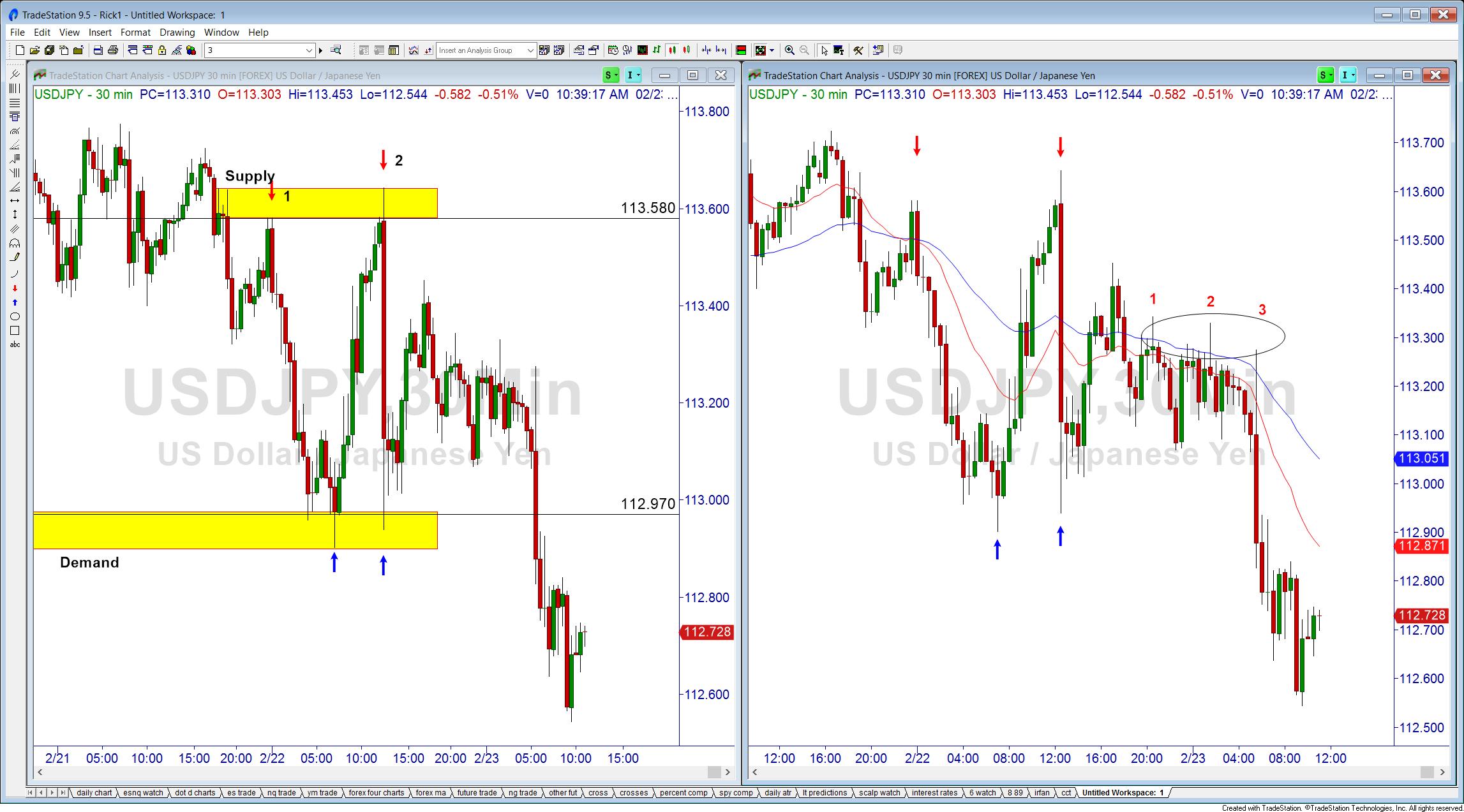
Notice where the red arrows are marked on the chart on the right. I haven’t seen a trading book yet that tells you to go short above a moving average like this! Now take a look at the blue arrows on the right-hand chart. How many trading books have you read that say to go long against the down-sloping moving averages? I would say none.
Let’s take this one step further. Using the rule mentioned earlier, some trading books suggest shorting when price moves up to the moving average. However, this only counts for the ENTRY. We also must be aware of our stop loss and profit target. Many trading book strategies tell you to place your stop loss just above the moving average that was used to enter the trade. Can you see a problem with this when looking at the red numbers 1, 2, and 3? Using that strategy, you would have been stopped out three times in a row! Not a great trading day…
So, the main take-away from this week’s newsletter should be this: all techniques have their time and place. But when and where are they? If you aren’t making money using them, they should obviously not be on your charts. Using supply and demand is the fastest way to get into and out of the market, when used with our entire core strategy.
This content is intended to provide educational information only. This information should not be construed as individual or customized legal, tax, financial or investment services. As each individual's situation is unique, a qualified professional should be consulted before making legal, tax, financial and investment decisions. The educational information provided in this article does not comprise any course or a part of any course that may be used as an educational credit for any certification purpose and will not prepare any User to be accredited for any licenses in any industry and will not prepare any User to get a job. Reproduced by permission from OTAcademy.com click here for Terms of Use: https://www.otacademy.com/about/terms
Editors’ Picks

EUR/USD slips back to daily lows around 1.1460
EUR/USD has started the week on the back foot, receding toward the 1.1460 zone, or daily troughs, at the end of Monday’s NA session. Firmer demand for the US Dollar weighed on the pair and the broad-based risk complex, as investors continued to assess the likelihood of further Fed tightening as well as reignited geopolitical tensions.

GBP/USD consolidates; bearish bias remains amid divergent Fed-BoE outlook
The GBP/USD pair consolidates above mid-1.3300sม and remains within striking distance of its lowest level since July 30, touched last week. Moreover, the fundamental backdrop seems tilted in favor of bearish traders and suggests that the path of least resistance for spot prices is to the downside.

USD/JPY holds small gains near 157.50 as JPY intervention risks loom
USD/JPY posts modest gains while trading near 157.50 in the Asian session on Tuesday as intervention fears help limit losses for the Japanese Yen. However, the BoJ's dovish rate hike to a 31-year high keeps JPY bulls on the back foot. Meanwhile, the US Dollar retains a bullish undertone amid the Fed's hawkish outlook and escalating Middle East tensions, providing tailwinds for the pair.
Editors’ Picks

AUD/USD picks up bids above 0.7100 after RBA-speak
AUD/USD picks up bids above 0.7100 in the Asian session on Tuesday, following hawkish comments from RBA Assistant Governor Sarah Hunter and Governor Michele Bullock. However, escalating tensions in the Middle East and the Fed's hawkish outlook remain supportive of the bullish US Dollar undertone, which could limit the pair. The crucial Trump-Xi summit is later this week and remains in focus.
USD/JPY holds small gains near 157.50 as JPY intervention risks loom
USD/JPY posts modest gains while trading near 157.50 in the Asian session on Tuesday as intervention fears help limit losses for the Japanese Yen. However, the BoJ's dovish rate hike to a 31-year high keeps JPY bulls on the back foot. Meanwhile, the US Dollar retains a bullish undertone amid the Fed's hawkish outlook and escalating Middle East tensions, providing tailwinds for the pair.

Gold lacks a clear directional impetus, with eyes on geopolitics
Gold struggles around $4,350 early Tuesday as sellers keep lurking at higher levels. US Dollar consolidates previous gains amid Oil price rebound and Treasury yields retreat. Gold’s daily technical setup paints a mixed picture, with a neutral daily RSI.

Ripple and Stellar outlook: Momentum improves as bulls target further gains
Ripple (XRP) and Stellar (XLM) stabilize on Tuesday after extending their gains by nearly 9% at the start of the week on Monday. Improving momentum indicators support XRP and XLM bullish price action and hint at further rally. Meanwhile, traders should remain cautious as mixed derivatives data could limit upside as both tokens try to sustain their recent upswing.

Iranian President will head to New York for UN meeting
President Masoud Pezeshkian will lead an Iranian delegation at the United Nations General Assembly in New York on Tuesday, amid renewed hopes for a diplomatic solution to the Middle East conflict, CNBC reported on Monday. A high-ranking Iranian delegation, including Foreign Minister Abbas Araghchi, will accompany President Pezeshkian.
RECOMMENDED LESSONS
Making money in forex is easy if you know how the bankers trade!

I’m often mystified in my educational forex articles why so many traders struggle to make consistent money out of forex trading. The answer has more to do with what they don’t know than what they do know. After working in investment banks for 20 years many of which were as a Chief trader its second knowledge how to extract cash out of the market.
5 Forex News Events You Need To Know

In the fast moving world of currency markets where huge moves can seemingly come from nowhere, it is extremely important for new traders to learn about the various economic indicators and forex news events and releases that shape the markets. Indeed, quickly getting a handle on which data to look out for, what it means, and how to trade it can see new traders quickly become far more profitable and sets up the road to long term success.
Top 10 Chart Patterns Every Trader Should Know

Chart patterns are one of the most effective trading tools for a trader. They are pure price-action, and form on the basis of underlying buying and selling pressure. Chart patterns have a proven track-record, and traders use them to identify continuation or reversal signals, to open positions and identify price targets.
7 Ways to Avoid Forex Scams

The forex industry is recently seeing more and more scams. Here are 7 ways to avoid losing your money in such scams: Forex scams are becoming frequent. Michael Greenberg reports on luxurious expenses, including a submarine bought from the money taken from forex traders. Here’s another report of a forex fraud. So, how can we avoid falling in such forex scams?
What Are the 10 Fatal Mistakes Traders Make
Trading is exciting. Trading is hard. Trading is extremely hard. Some say that it takes more than 10,000 hours to master. Others believe that trading is the way to quick riches. They might be both wrong. What is important to know that no matter how experienced you are, mistakes will be part of the trading process.
The challenge: Timing the market and trader psychology

Successful trading often comes down to timing – entering and exiting trades at the right moments. Yet timing the market is notoriously difficult, largely because human psychology can derail even the best plans. Two powerful emotions in particular – fear and greed – tend to drive trading decisions off course.